
What is Seattle Hub for Synthetic Biology technology?
Explore the resources below to learn about Seattle Hub for Synthetic Biology cell and genome programming technology. We encourage potential Fellow’s to think creatively about incorporating aspects of Seattle Hub for Synthetic Biology technology into their independent research proposals. Be sure to read about what our current SeaBridge Fellows are working on here.
DNA Typewriter is a molecular recording tool that uses prime editing to write genetic barcodes into a cell’s DNA. These barcodes create a chronological record of cell divisions, allowing researchers to trace cellular lineages over time.
DNA Typewriter has three key components:
- Symbols: Short, 5-nucleotide DNA sequences that serve as the system’s building blocks.
- Medium: A designated region of the genome, called “DNA Tape,” where these sequences are inserted and recorded.
- Reading order: The insertions are read in the 5′-to-3′ direction, allowing researchers to reconstruct the sequence of recording events and trace a cell’s lineage over time.
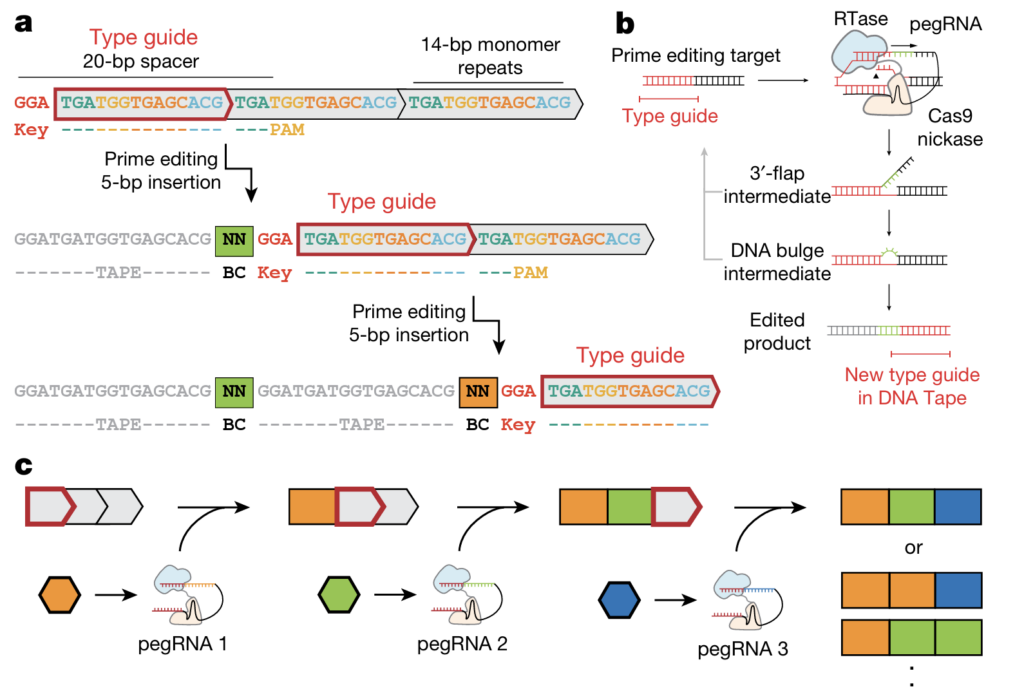
Figure 1A-C from Choi, J., Chen, W., Minkina, A. et al. A time-resolved, multi-symbol molecular recorder via sequential genome editing. Nature 608, 98–107 (2022). https://doi.org/10.1038/s41586-022-04922-8
ENGRAM Enhancer-driven genomic recording of transcriptional activity in multiplex. ENGRAM records transcriptional activity by using signal-dependent prime editing guide RNA production to insert signal-specific barcodes, or “symbols,” into a genomic recording unit.
Key capabilities:
- Multiplexed enhancer recording: Captures cell-type-specific activity across hundreds of cis-regulatory elements.
- Time- and concentration-dependent recording: Tracks the activity of signaling pathways and gene expression systems, including WNT, NF-κB, and Tet-On.
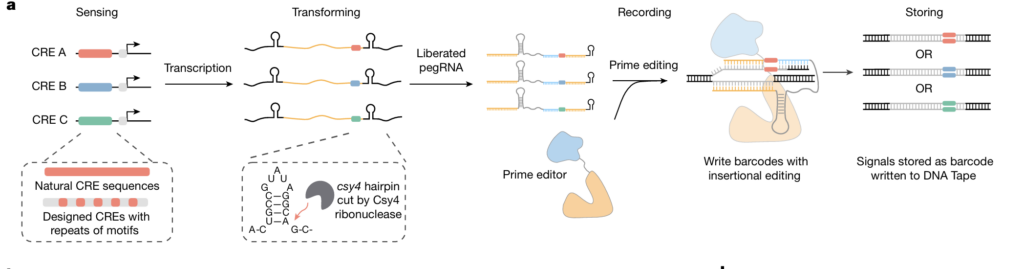
Figure 1 A from Chen, W., Choi, J., Li, X. et al. Symbolic recording of signalling and cis-regulatory element activity to DNA. Nature 632, 1073–1081 (2024). https://doi.org/10.1038/s41586-024-07706-4.
Non-exhaustive list of ways to use DNA Typewriter & ENGRAM
- Use of ENGRAM to improve target identification in drug development
- Development of DNA Typewriter compatible sensors
- Use of Typewriter/ENGRAM to improve CAR-T manufacturing
- Use of Typewriter/ENGRAM to improve CAR-T performance in vivo
- Use of Typewriter/ENGRAM for autoimmune target identification
- Development of HSV as a tool for big DNA delivery in mouse-making
- Engineering iPSCs to reduce the need for growth factor addition
- Use of ENGRAM as a tool to evaluate toxicity of drug candidates
- Using biological recorders to create datasets for machine learning training
- Programmable cell therapies from iPSCs
- Implement and optimize multiplex signal recording in an organoid model
Check-out how our current SeaBridge Fellows are using DNA Typewriter & ENGRAM here.
Below is a selection of publications highlighting technologies developed at the Seattle Hub for Synthetic Biology.
- DNA Typewriter: A time-resolved, multi-symbol molecular recorder via sequential genome editing.
- ENGRAM: Symbolic recording of signalling and cis-regulatory element activity to DNA.
- Sci-RNA-Seq: Optimized single-nucleus transcriptional profiling by combinatorial indexing.
- Embryo-scale single-cell chemical transcriptomics reveals dependencies between cell types and signaling pathways
- A statistical framework for inferring genetic requirements from embryo-scale single-cell sequencing experiments
- DNA Typewriter in mice: A DNA Typewriter records the cell lineage history of a mouse, from zygote to late organogenesis
Still unsure if your proposal is utilizing the technology? Submit a request for a meeting below.